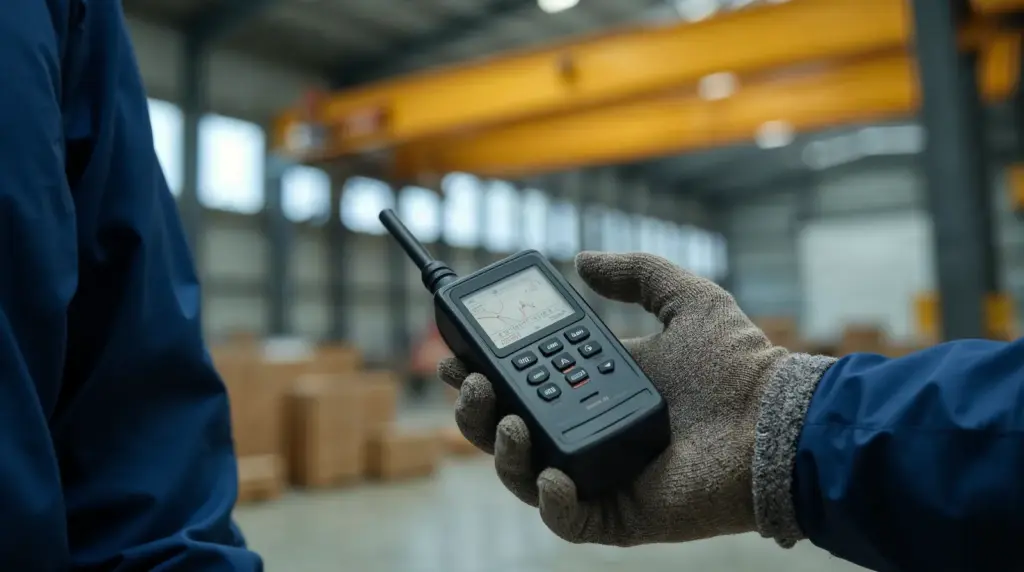
Before car fobs became common, industrial sites relied on a close cousin: the radio remote for overhead cranes. Those chunky, rubber-armoured transmitters sent coded UHF commands across noisy factory floors. Engineers trusted them to move heavy loads without a wired pendant. The same core idea, a short-range radio link paired with an intelligent receiver, quietly migrated into passenger vehicles.
What changed was not the physics but the packaging. A crane remote can be much larger and heavier than a car fob. A modern car fob slips into a pocket and survives washing machines, sand and daily drops. Yet both devices share a common technical lineage: a binary-modulated carrier, a rolling or fixed code, and a receiver that decides whether the command is valid. Understanding that lineage explains why today’s fobs behave the way they do.
The Industrial Radio Foundation
Security on early industrial systems was often simple. A fixed address code set by DIP switches had to match between transmitter and receiver. That was enough when the main risk was accidental activation by another nearby machine. But as radio modules became cheaper, the same approach appeared in early car remotes. Thieves quickly learned that fixed codes could be captured and replayed, which pushed both industries toward rolling-code techniques.
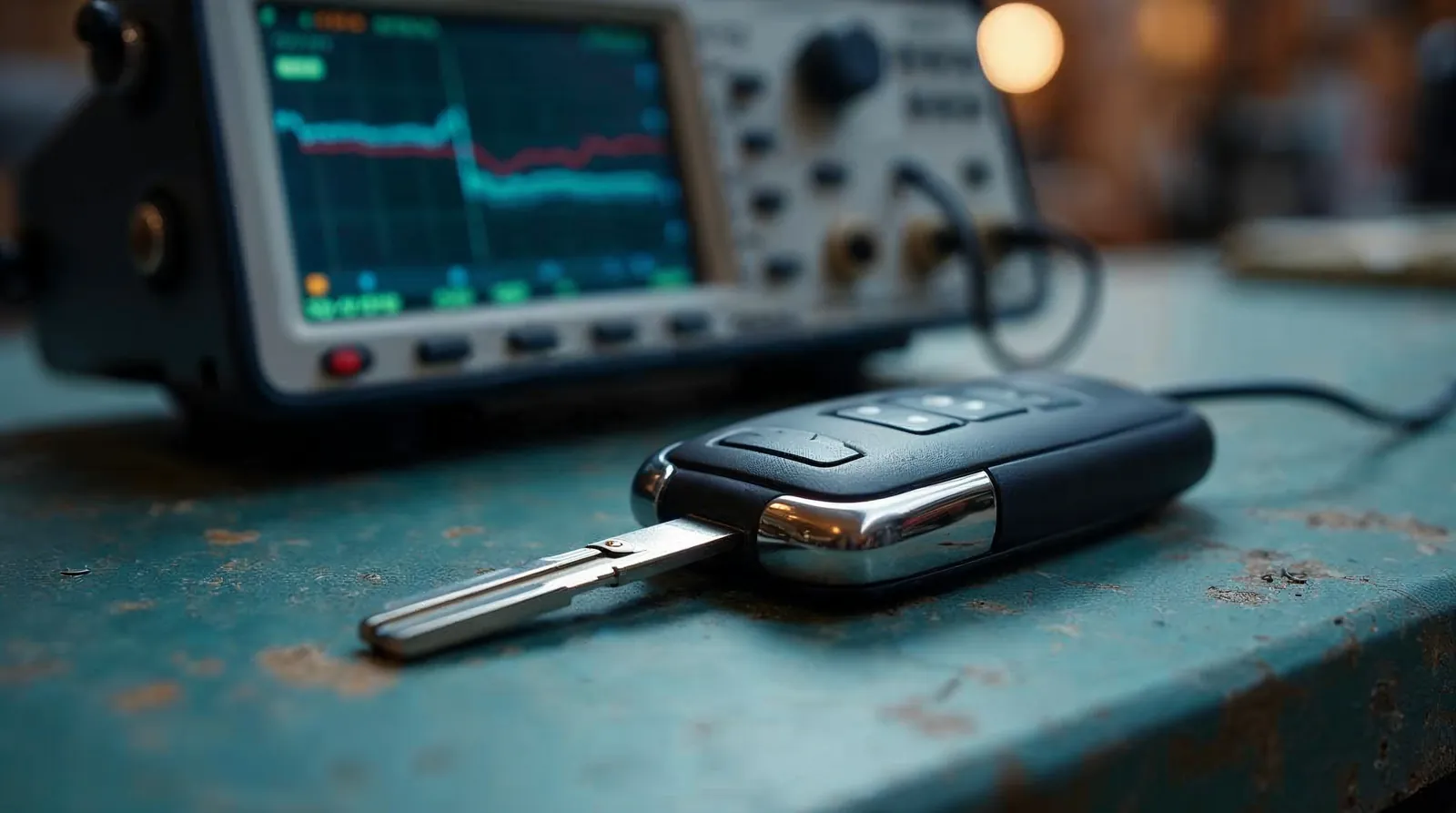
Modular digitizers used for testing reveal how demanding these signals can be. A typical RKE packet might last 269 milliseconds at a carrier of 433.92 MHz. Capturing that long burst without losing the fine detail of amplitude or frequency shifts requires instruments that can store millions of samples. The measurement challenge is nearly identical whether the transmitter sits on a crane or on a key ring.
From Fixed Codes to Rolling Security
The radio layer beneath those buttons used either amplitude shift keying or frequency shift keying. In ASK, the transmitter varies the carrier amplitude between two levels. In FSK, the carrier jumps between two distinct frequencies. Data packets typically ranged from 64 to 256 bits, sent at 1 to 20 kilobits per second. Each packet carried a preamble, a command code and a rolling code that changed with every press.
That rolling code is the quiet hero of modern vehicle access. It means the same unlock command never sounds exactly the same twice over the air. A captured signal becomes useless for a later replay attack. The body control module inside the car checks the rolling code against its own synchronised counter. If the sequence is valid, the doors unlock or the engine start command is accepted.
Regional Frequencies and Their Quirks
For drivers in some regions, imported vehicles can carry any of these regional setups. A Japanese-market car may transmit on a band that local test equipment does not expect. A European-spec vehicle may use 868 MHz, which behaves differently around metal and glass than 433.92 MHz. Technicians who understand these splits can diagnose range problems without blindly replacing batteries or fobs.
The modulation scheme also matters for compatibility. Some receivers are more tolerant of frequency drift than others. Heat, humidity and ageing crystals can pull a transmitter slightly off its nominal frequency. A receiver tuned for FSK may reject a weak ASK signal even if the button press feels identical to the driver.
Design Milestones That Shaped the Fob
Security electronics arrived piece by piece. Chevrolet added a coded resistor to the 1986 Corvette key, creating the Vehicle Anti-Theft System that spread through GM cars in the 1990s. The 1990 Lexus LS400 used a laser-cut key that was harder to duplicate. The 1990 Mercedes-Benz SL introduced the switchblade key, folding the blade into an integrated remote-locking fob. That design was widely copied and still appears on many modern Volkswagens.
Proximity technology changed expectations further. The 1993 Chevrolet Corvette could lock and unlock its doors by detecting the fob nearby, though the driver still needed a traditional key to start the engine. The 1998 Mercedes-Benz S-Class went further with keyless proximity ignition. By then, the fob was no longer something you pointed at the car. It was something the car simply recognised.
How a Modern Packet Is Built
The whole packet may last only a fraction of a second. A near-field acquisition of one 433.92 MHz RKE packet measured 269 milliseconds. Inside that window, the carrier switches state hundreds or thousands of times. Each transition must be clean enough for the receiver to decode. Dirt on a button, a weak battery or a cracked solder joint can smear those transitions and cause intermittent failures.
Testing these signals requires patience and the right capture tools. A modular digitizer can record the long burst and let a technician zoom into individual bit transitions. That is how labs verify that a fob meets its timing budget. It is also how field engineers confirm that a replacement fob is not drifting outside the receiver’s tolerance.
Practical Lessons for Gulf Drivers
Sand and fine dust are equally patient saboteurs. They work into button gaps and battery contacts. A fob that works only when pressed hard may have a dirty contact pad rather than a dead battery. Cleaning the internal contacts with a dry brush often restores full function. If the case is cracked, replace it before humidity reaches the circuit board.
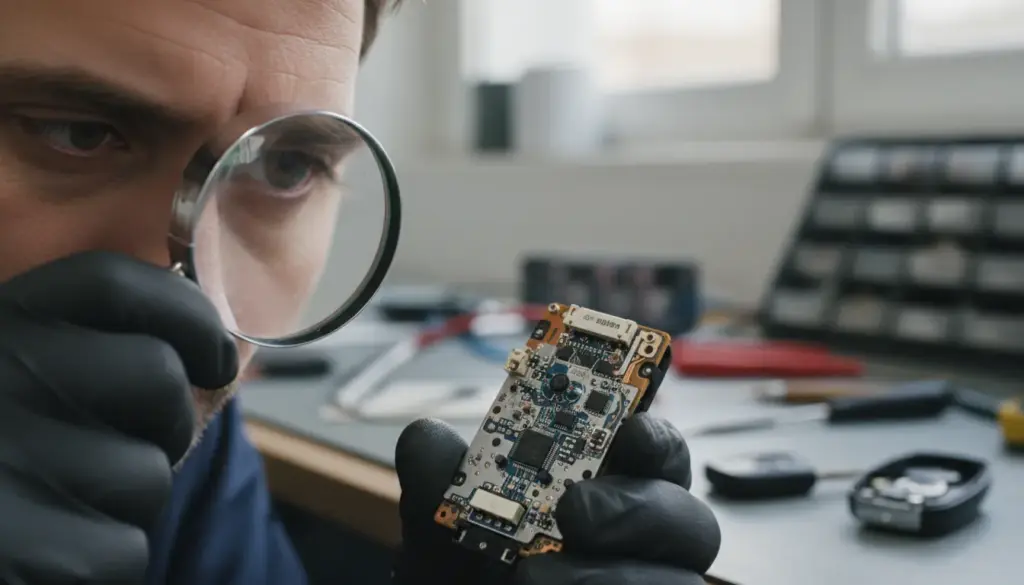
When a fob fails, the cause is rarely the rolling code itself. The usual suspects are the battery, the buttons, the antenna connection or the receiver module in the car. A systematic check costs less than a new dealer fob. Start with the battery, then inspect the board under magnification, then test the signal with a frequency counter or digitizer if one is available.
What to Check Before Reprogramming
The following checks will save time and money on almost any radio key problem. Modern key fobs are miniature electronic powerhouses that use ultra-high frequency transmitters, typically operating in the unlicensed industrial, scientific, and medical bands at frequencies like 315 MHz or 433.92 MHz. They send data packets containing a command code for functions such as locking doors or starting the engine, along with a rolling code that changes with each use to maintain security. These packets, often between 64 and 256 bits long, are transmitted using binary modulation schemes like amplitude shift keying or frequency shift keying. Because the combination of a high carrier frequency and a relatively long transmission duration makes signal analysis challenging, using the right measurement approach is essential for effective troubleshooting.
- Replace the battery with a fresh cell from a known brand and note the correct orientation before removing the old one.
- Inspect the button contacts and battery terminals for corrosion, dust or a cracked solder joint under bright light.
- Test for RF output with a simple detector or digitizer to confirm the fob is transmitting on its expected band.
- Check the vehicle receiver area for water damage, loose connectors or aftermarket electronics that may cause interference.
- Verify the regional frequency of the car and fob, especially on imported vehicles from Japan, Europe or North America.
- Confirm that the body control module responds to other commands, such as the interior lock switch, before blaming the fob.
- Record any error behaviour in detail, including range, angle and whether the problem occurs only in certain locations.
After these checks, programming can be attempted with confidence. Many vehicles allow owner programming through a sequence of ignition and door operations. Others require a diagnostic tool. In either case, the radio link must be healthy first. A clean, well-powered fob on the correct frequency is the foundation of every reliable remote access system.